Cubby Law logomark
Cubby Law
How It WorksWhat Cubby DoesFAQ

Know your professor.
Beat the curve.

The AI teaching assistant for law school. Trained on how your professor teaches, tests, and grades.

Top half of your class guaranteed, or your money back.

Close Streamline Icon: https://streamlinehq.com
Practice Exam
Graduation Hat Streamline Icon: https://streamlinehq.comTailored ExamArrow Right 1 Streamline Icon: https://streamlinehq.com
tailored-exam.pdfArrow Right 1 Streamline Icon: https://streamlinehq.com
Feedback
Exam grade score display showing student performance
85
Cubby Tailored ExamContracts Exam
In the style of Professor Pinder
Donna AI assistant signature seal
Study syllabus checklist icon
Actionable StepsThings you can do to improve.
Review outline chapterPre-Existing Duty and Duress
Question individual feedbackReview your performance question-by-question with targeted feedback.
Pane left iconLeft side split view
QuestionAnswer
Question 1 of 32
Question
Double space!Good luck!
Exam - Jan 26th, 2026Page 2 of 6

Question 1

Tom and Jerry entered into a written contract for the construction of a house for Tom on land that he owns. The house was to be built according to very detailed plans and specifications prepared by Tom's architect. The contract price was $750,000, payable in four equal installments, the first when the foundation was poured, the second when the house was framed, the third when the electrical and plumbing work was completed, and the fourth at completion of the house. The contract also provided that "time was of the essence." The contract was signed on March 1, and Jerry began work on March 3. By March 15, Jerry's workers had excavated the site and were ready to pour the foundation. At that point, they discovered that the soil conditions were much more severe than anticipated. The soil was like quicksand and would not hold a normal foundation without additional work. This work would add $100,000 to the cost of the project. Jerry immediately stopped work and contacted Tom. He explained the problem and asked Tom to agree to pay the additional $100,000. Tom was very upset, protesting that it was not his responsibility to pay for the additional work. Nevertheless, he agreed to the price increase, since he felt he had no choice and he wanted the house built as quickly as possible. Jerry then resumed work.

0%

of Cubby students finished in the top half of their class.

0%

finished in the top 20%.

0+

law students last year

"Using Cubby earned me an A+ in Civil Procedure and an A- in Contracts, a class I struggled with all semester."

M

Matt

Delaware 1L

About Cubby
Security & PrivacyTerms of ServiceGuarantee Terms
Partnerships
For ProfessorsFor Student Organizations
Resources
Ethical AI ManifestoAcademic Integrity Policy
Connect
X (Twitter)InstagramLinkedIn
Cubby Law Logo
Cubby Law Logo
Feedback
Right side split viewPane left icon
Question 1 of 32
Feedback

Main Takeaways

What was done well

You clearly framed the modification question tied to the unforeseen foundation conditions and then analyzed the Reading-brand substitution using substantial performance and economic waste, concluding that damages are limited to diminution in value and likely nominal.

What was missing

You did not set out the impracticability elements or authorities (Restatement § 261; Transatlantic) and did not explicitly evaluate whether the non-occurrence of stable soil was a basic assumption and whether reasonable alternatives existed.

Improvements for next time

For the modification, explicitly weigh Restatement §§ 73 and 89 and Alaska Packers (outline IV.1) and, if asserting duress, apply R2d 175's elements (outline IV.1 Duress) to Tom's "no choice" claim.

Issue 1

Contract Modification—Pre-Existing Duty Rule and §89 Exc.
78 / 100

Assesses enforceability of the mid-project price increase under the pre-existing duty rule versus the §89 fair-and-equitable modification exception, including the duress counterargument.

Issue and sub-issue spotting
20 / 20
Rule statements
14 / 20

How it Works

Cubby analyzes your professor's teaching style, course materials, and past exams to create a personalized study system you can rely on from day one of the semester through finals.
Highlighter

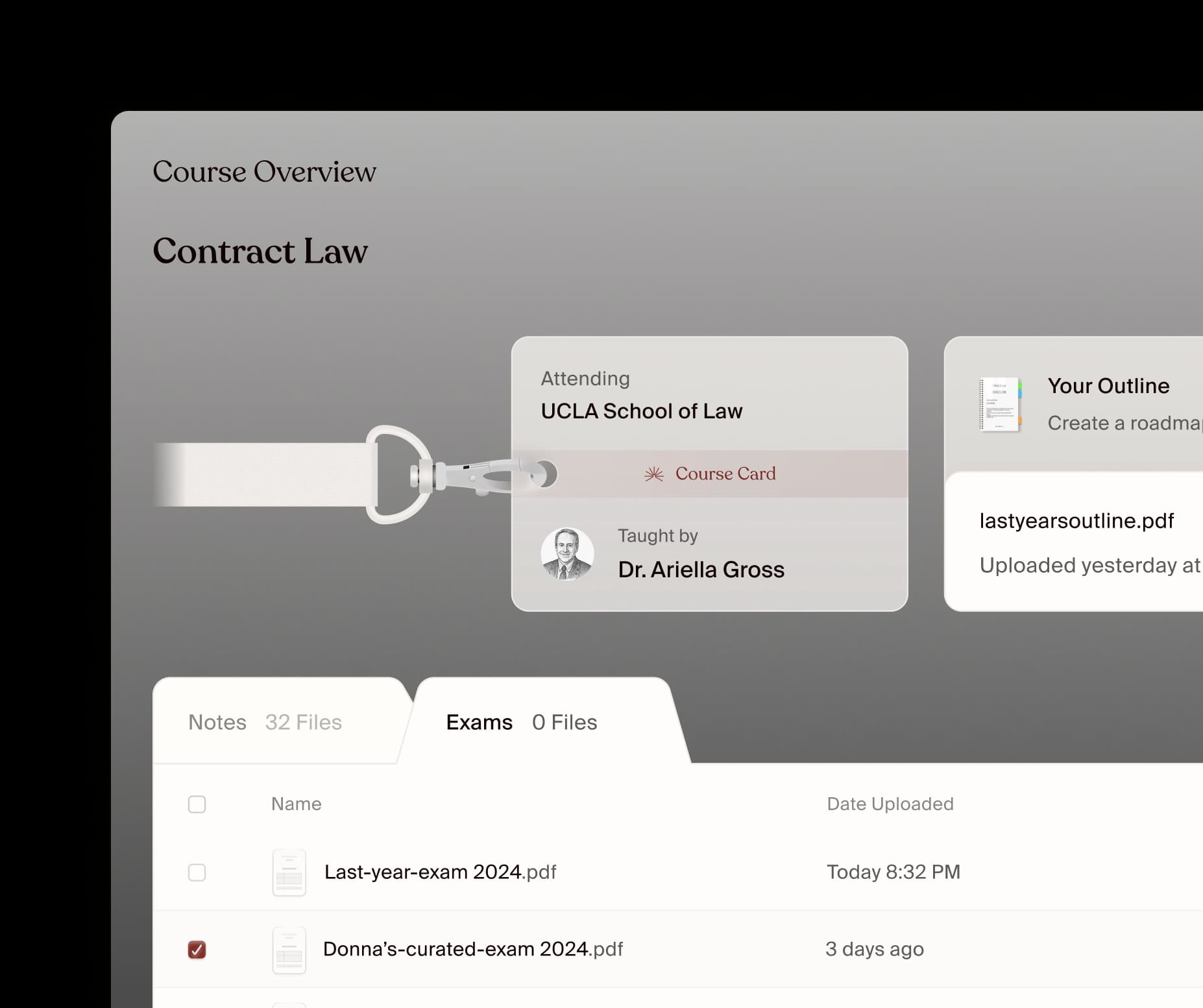
Professor-Specific Setup

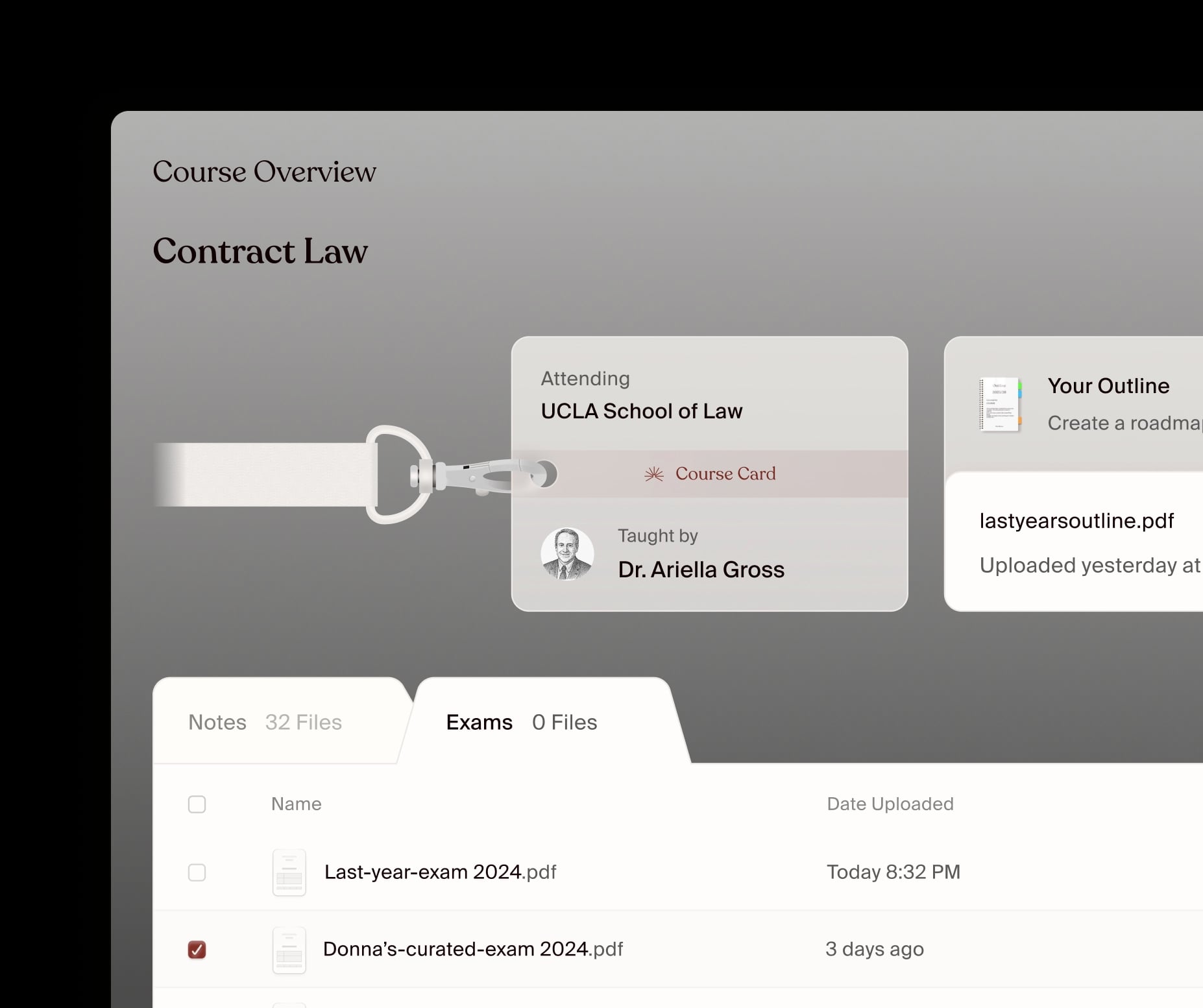
Upload your outline, notes, slides, and past exams. Cubby adapts to your professor’s teaching approach, emphasis, and exam style, so your practice mirrors how you’ll actually be tested.

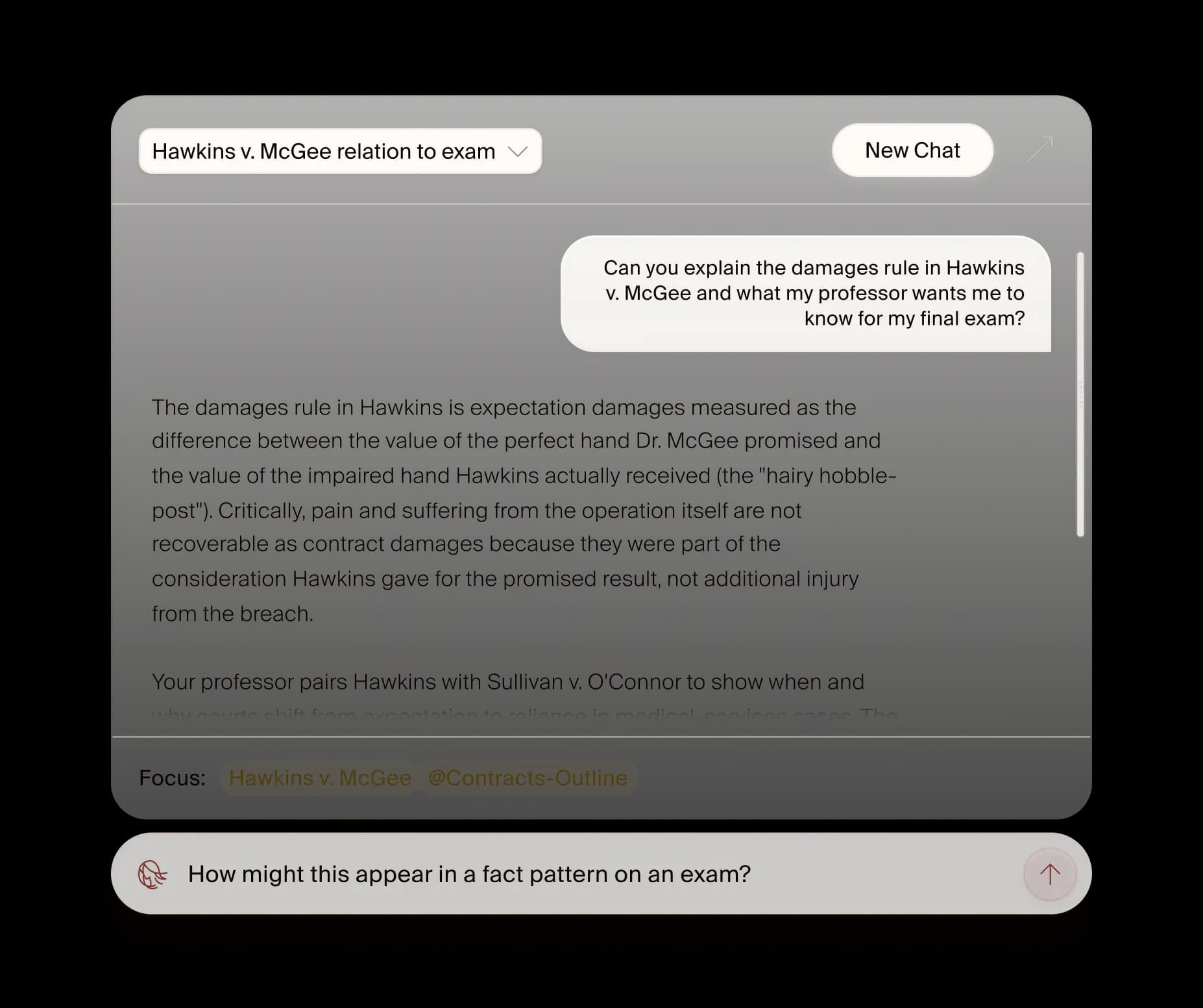
Study With Closed-System AI

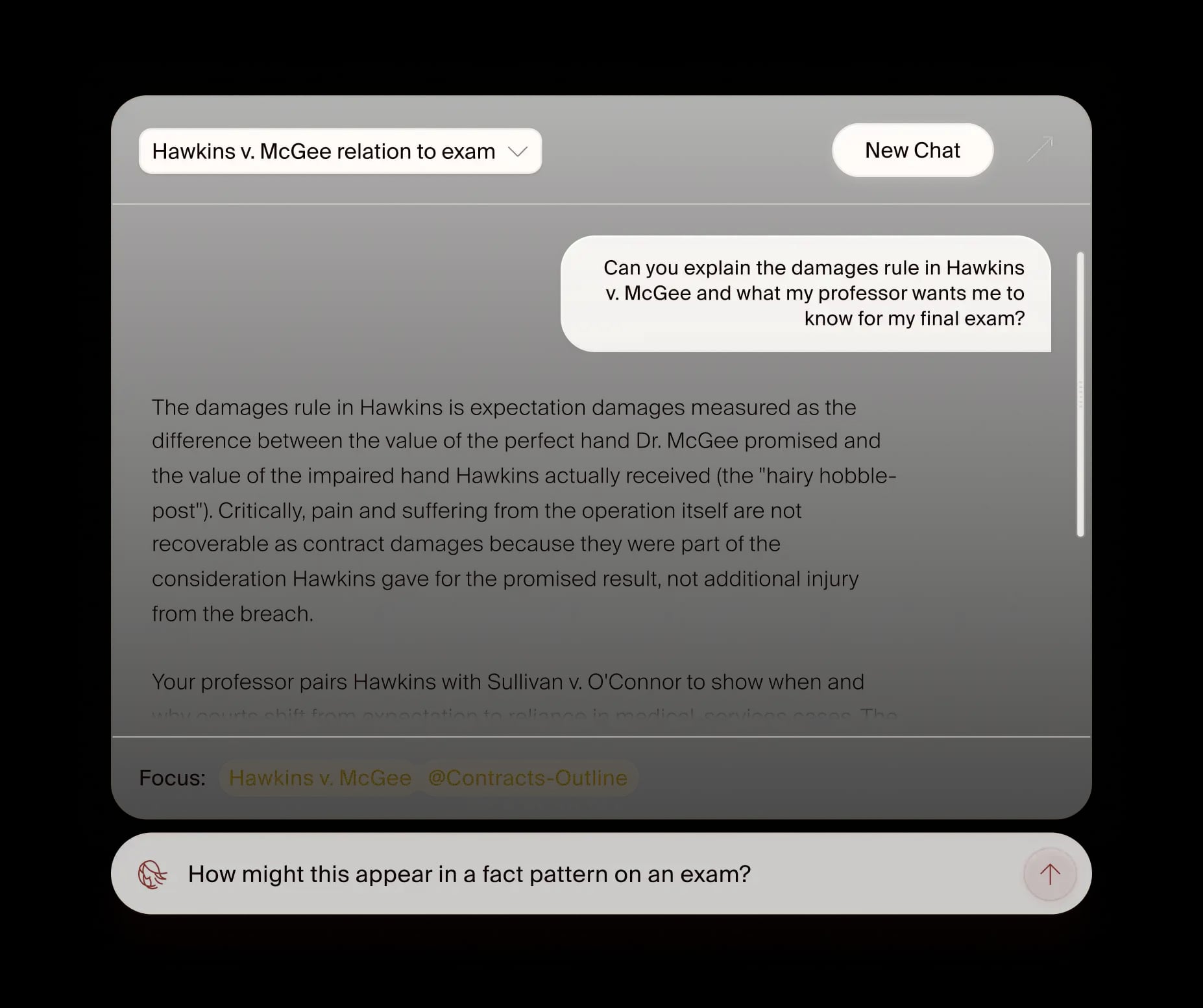
Use Donna, Cubby's AI teaching assistant, to ask questions and receive explanations grounded in your uploaded materials.

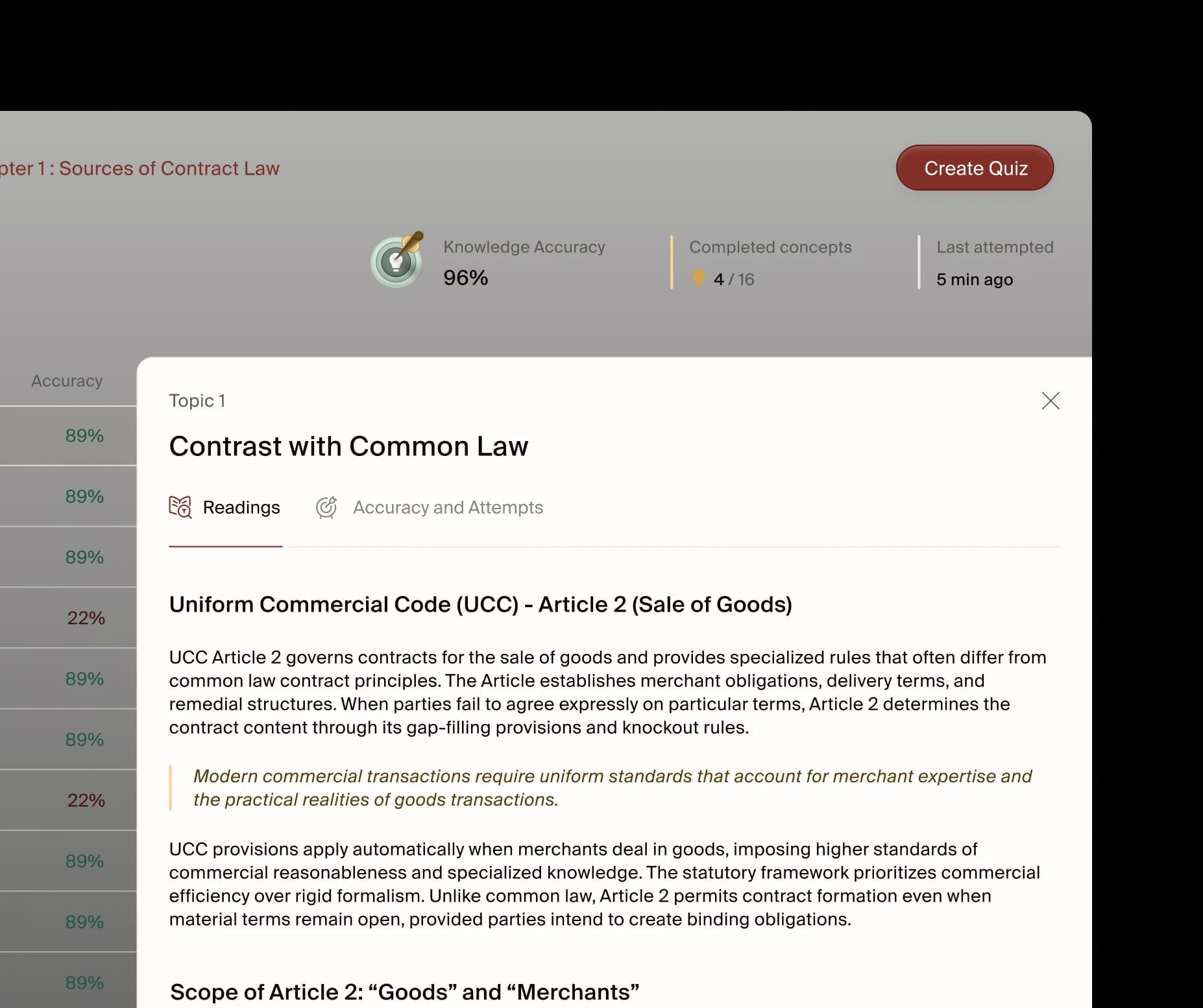
Practice All Semester

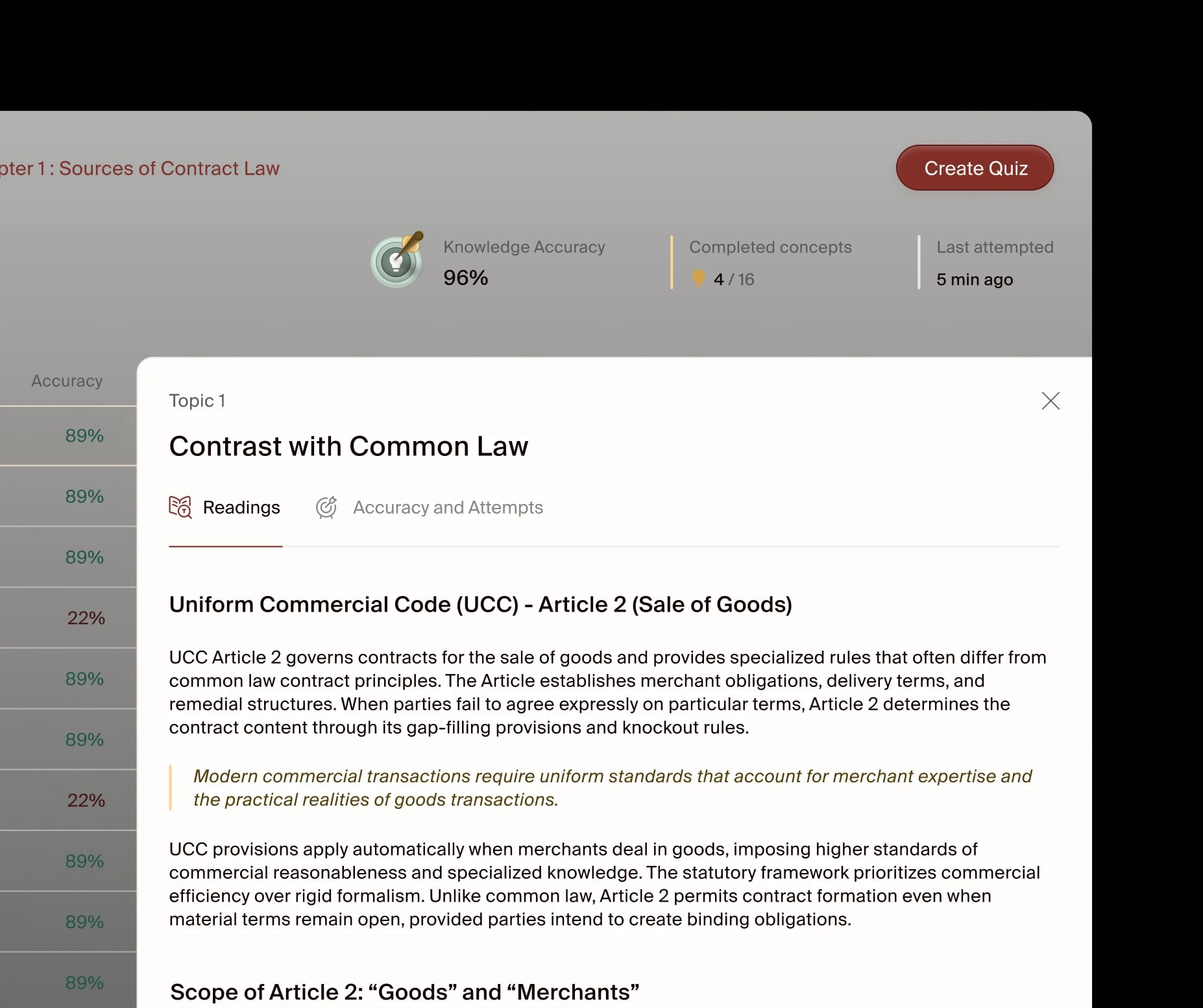
Prepare for cold calls, reinforce concepts with outline quizzes, and generate unlimited professor-specific practice exams with instant grading and feedback.
Professor-Specific Setup
Study With Closed-System AI
Practice All Semester

Professor-Specific Setup

Upload your outline, notes, slides, and past exams. Cubby adapts to your professor’s teaching approach, emphasis, and exam style, so your practice mirrors how you’ll actually be tested.
Professor-Specific Setup

Study With Closed-System AI

Use Donna, Cubby's AI teaching assistant, to ask questions and receive explanations grounded in your uploaded materials.
Study With Closed-System AI

Practice All Semester

Prepare for cold calls, reinforce concepts with outline quizzes, and generate unlimited professor-specific practice exams with instant grading and feedback.
Practice All Semester

Professor-Specific Setup

Upload your outline, notes, slides, and past exams. Cubby adapts to your professor’s teaching approach, emphasis, and exam style, so your practice mirrors how you’ll actually be tested.
Professor-Specific Setup

Study With Closed-System AI

Use Donna, Cubby's AI teaching assistant, to ask questions and receive explanations grounded in your uploaded materials.
Study With Closed-System AI

Practice All Semester

Prepare for cold calls, reinforce concepts with outline quizzes, and generate unlimited professor-specific practice exams with instant grading and feedback.
Practice All Semester
A professor's portrait, the way Cubby maps how they teach, test, and grade

Professor Intelligence

We already know your professor.

When you sign up, Cubby already knows how your professor teaches, tests, and grades. That intelligence powers every brief, quiz, practice exam, and piece of feedback you get from day one.

Proven Results

Stories from students who used Cubby to gain an edge.
Architectural pillar background
2000students used Cubby last year
Video thumbnail

I previously struggled with taking practice exams and having no idea how I did but Cubby filled that gap because I can now get feedback on my responses.

~ Colby
Video thumbnail

Cubby gave me a centralized location to transform my studying into a much more active, practice based review

~ Mia
"Helping students master material, boost GPAs, and stand out amid law school's most competitive year in decades."
Yahoo finance logo
Read more about us
Video thumbnail

I used to make flashcards and ask ChatGPT to create complex exams, but it wasn’t tailored to my professor or outline like Cubby is.

~ Tulio
Video thumbnail

Cubby gave me great feedback on my responses so I walked into exams feeling really confident and well prepared

~ Emma
Video thumbnail

Cubby gives you the best briefs, multiple-choice, and essay questions I’ve ever seen and their AI actually understands law school nuances in a way that no generic tool does.

~ Liam

Faculty Advisors

Shaped by law professors. Built for law students.

Cubby is built in collaboration with faculty at leading law schools, ensuring it reflects how the law is actually taught in the classroom.

Jonathan Askin
Jonathan Askin, J.D.

Professor of Clinical Law. Brooklyn Law School, Visiting Professor at Stanford University.

Faculty Advisor
Wayne Unger
Wayne Unger, J.D.

Associate Professor of Law. Quinnipiac University School of Law.

Faculty Advisor
Franklin Lebo
Franklin Lebo, J.D., Ph.D.

Director of Academic Excellence and Assistant Teaching Professor. Emory University School of Law.

Faculty Advisor
Kevin Frazier
Kevin Frazier, J.D.

AI Innovation & Law Fellow. University of Texas School of Law.

Faculty Advisor

What Sets Cubby Apart

Same class. Same professor. Different outcome.
Training
Closed legal AI system
Class prep
Practice
IRAC feedback
Built for law school
Trained strictly on law school materials
Specialized legal intelligence model grounded in your materials to ensure accuracy
Professor-specific insights for every case
Unlimited outline quizzes and practice exams with instant grading
Detailed analysis on every response
Designed specifically for law school and exam success
Quimbee
Standardized, one size fits all content
Pre-written content library
Generic case summaries
Limited question sets
No feedback or grading
Focused on class prep, not exam performance
ChatGPT
Trained on a broad and diverse data set
Draws from the open internet and can hallucinate
No built in structure or context
No integrated practice or grading tools
No law school specific writing framework
General-purpose AI

Guarantee

Top of your class or your money back.

Use Cubby consistently through the semester. If you don't finish at the top of your class, you get your money back.
See guarantee terms
Example final examination with a grade of 94 from UCLA School of Law, Contract Law - Fall 2025
Contract Law - Fall 2026
0

Frequently Asked Questions

Everything you need to know.

Yes. 90% of users finished in the top half in their classes last year. 55% finished in the top 20%. 2Ls saw an average GPA increase of 0.25 compared to previous semesters. Cubby is effective because you're not studying the law in the abstract. You're studying exactly how your professor teaches and tests it.

Fall 2026 access
opens in August.

Apply for the cohort.